
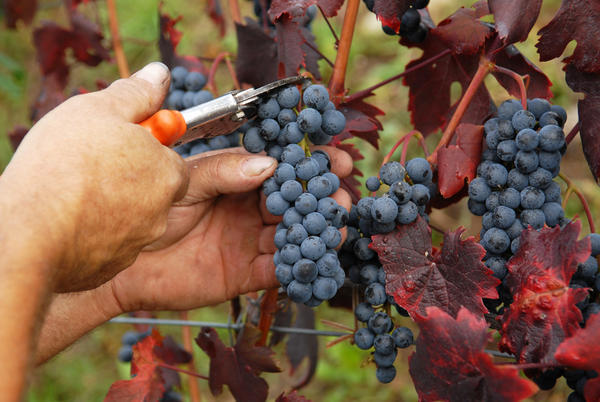
Drought and heat the real culprits. Weather extent of the losses on the grapes early, it could be revised upwards, thanks to the rains in September that determined mainly red grapes more later. Meanwhile, however, due to the reduced presence of pests, the quality of the grapes from the good promises excellent with a sugar content higher than average.
For the new harvest is expected in Italy another record low. The minus 8% compared to a 2011 that had already dragged lows the national wine production, would bring the matter of this year under the threshold of 40 million hectoliters. The expected ISMEA and the Italian Wine Union, pointing out that the main cause of the reduction was not this year of a structural nature, ie linked with grubbing premium, dropouts or other measures of the CMO, such as green harvest. Drought and heat are the real culprits of the scarcity of Italian wine in the cellars. With a schedule back to normal, even though there have been significant advances certainly less than last year.
The reductions are accentuated in the North-East in particular, with Friuli coming to -21%, -12% in the Veneto, and Trentino Alto Adige and Emilia Romagna recorded a decline of 10%. Also for the North-West, in the main producing regions of Piedmont and Lombardy, it is estimated a significant reduction, respectively - 8 and -15%.
Situations where alternating Center -10% to -20% in Tuscany and Umbria are flanked production in line with those of last year for Marche and Abruzzo, while only a slight decrease is expected in Lazio. To be considered, however, that to be broadly in line with 2011 is not the 2012 a good year, indeed.
In the South, however, decided to resize the Apulia (-15%), is accompanied by a recovery in production of Campania, and especially in Sicily. The island was mainly the lower the green harvesting to bring about positive ground hands harvest estimates.
Estimates that, now stored losses, sometimes significantly, the early grapes, may still be affected by the weather. The rains of early September, in fact, have given a little 'hope to grape producers more later especially red. But things could change for the worse if the rain will be abundant and especially close to the harvest.
Meanwhile, however, due to the reduced presence of pests, the quality of the grapes from the good promises excellent with a sugar content higher than average.
Be necessary at this point to see how the market react seen that the harvest does not occur only in poor Italy. After the drop in production recorded during the spring in the Southern Hemisphere, in fact, even the cellars of the Old Continent may be far from full.
Here are the details: Regional:
Piedmont (-8%). The weather situation has affected all the vegetative stages of the vineyard in Piedmont. First a very cold winter, then a spring marked instability, with a prevalence of bad weather and frequent rains have increased the supplied water in the soil used extensively during the long summer drought and warm. Flowering and fruit were made according to a schedule normal, but were rather long and with mixed results, and in the media you can still set close to good. This situation has affected the production volumes of a year that already did not look particularly abundant. The summer heat has also started to create a problem by mid-June, with a sultry first period, the month of July then took the right tradeoffs between the warm and refreshing time. Hot and no rain was, however, almost the entire month of August. Only in the last part of the weather pattern has changed to a pattern autumn, with warm days and nights quite cool, creating the right temperature range that allows the formation of flavors in the grapes. The drought has created problems particularly in the sunny hills, where the grape is slightly wilted. The heat, however, led to a general underperformance.
At the end of July is still assumed a harvest in the canonical times, but the month of August has changed the cards on the table, accelerating the maturation and promoting again a year early: The grapes for sparkling base were collected soon after mid-August, followed by white for still wines. In the last days of August kicked off the harvest of Brachetto and Moscato that, while Arneis, Cortese, Favorita and Erbaluce is expected in September. Good state of maturation also of black grapes early as Dolcetto, whose harvest has started with the first of September. The rains in early September have revived the vineyards and the sun the next few days bodes well for perfect ripening also Nebbioli that will be harvested later this month instead.
From the point of view of plant health the year has not reserved any particular problems, except for some cases of late blight in May and June and other powdery mildew in the most humid weather. Concerns remain for flavescence, the resurgence of which continues to manifest itself in particular where viticulture is marginal. The hail struck with the usual randomness, but in a very intense way, some areas in Casale, Monferrato Agliano d'Asti and Moasca in between Barolo Barolo and Monforte and Roero to Monticello d'Alba and Pocapaglia.
For the quality, there are good prospects for a harvest of excellent quality. There are some hesitations for aromatic grapes because of the hot August. However, the current situation more moderate climate could also help these productions.
Even for Lombardy (-15%) the distinctiveness vintage was the drought, which has affected the production in terms of quantity and the expected quality ranges from good to very good.
In the vast area at Pavese the first phenological stages, start with a early budding of approximately 10 days compared to the average, are considered good, while the drought has disturbed then be final. The advance has gradually recovered, and the vintage of Pinot Noir for sparkling bases began just after mid-August. In accordance with the incidence of major diseases and has been the impact of the hail, however, concentrated in a narrow range in the western hills.
Moving in Franciacorta shows a vegetative cycle started in the standard from the point of view of the calendar but with un'allegagione rather poor, while the other phases have been very good. As usual, the collection began with the Chardonnay. From the point of view of pathologies, we report a higher incidence this year mildew but the incidence on lower yields is essentially due to drought.
Remaining in the Bresciano but shifting the focus to the area of Lugana shows vegetative development which took place according to a schedule normal, although the final stages were also disturbed by the continuing drought here, despite the use of irrigation rescue.
Excellent quality expected Valcalepio, despite a mediocre bloom then recovered by the good performance of the subsequent stages to maturity, if affected by the drought. A pathological level you are experiencing attacks of botrytis in after flowering, and powdery mildew in summer.
Unlike the rest of the region, in Valtellina vegetative departure was delayed for about a week with excellent flowering followed by berry set and veraison good. There was an increase of blight during the season while the other adversities have played a minor role. Some damage from hail.
Staying in the North West we note the substantial stability of the Valle d'Aosta (=) where all the phenological stages, also in line with a normal schedule, can be considered good. In some areas flowering and did not appear as expected. Some damage from spring frosts has had in the vineyards at high altitude. Also good quality expected.
Down in Liguria (-10%) on the previsoni production volumes are in line with the expected average in the North-Western and Italian in general. Great expectations on quality.
Rather significant declines in the North-East from those estimated for Trentino Alto Adige (-10%). Although some differences between the province of Bolzano, in line with or slightly below last year's volume, and that of Trent, where the decline is significant, the region presents a harvest limit of one million hectoliters. In Trentino, where weather conditions were more favorable, especially in the valley floors, the decline in production - due to the lower weight of the bunches that are sparse with respect to the media, especially the Pinot Gris and Chardonnay - can be attributed mainly to three causes: the cold winter resulting in uneven germination, the freezing of the first decade of April and the June rains which have affected the flowering.
In the vineyards on a hillside these problems were less pronounced or even absent. The reference is to Muller Thurgau grapes, Teroldego, Merlot and Cabernet Sauvignon in particular. The intermittent rain gave a boost to the vegetation of the screws making appropriate efforts, sometimes repeated, bevel and flaking. Reduced and limited to certain varieties the use of manual pruning or trimming of the clusters.
The harvest of Chardonnay grapes for sparkling wine began after August 20 at a fast pace, followed by Chardonnay destined to still wine, and Pinot Gris, Muller Thurgau and other aromatic white varieties. The second week of September sees the start of the grapes Teroldego and then continue with Merlot, Marzemino end of the month and the Cabernet Sauvignon. The red varieties, moreover, will have the giovamenti rains earlier this month and the good weather that followed. Few events grandigeni, other than that pretty important that hit the hills of Vallagarina and some limited areas of the valley.
The state of health of the grapes is generally excellent.
In South Tyrol you expect a harvest with volumes equal to or slightly lower than last year. This is the result, however, of an algebraic sum of the flexion provided for white grapes like Pinot Grigio and Gewürztraminer, which may have lost between 5 and 10%, and the good increase expected for the red especially for Schiava . Reduced or zero damage from drought seen that most of the plants have the possibility of using irrigation.
Veneto (-12%). The impact of prolonged and intense heat and low rainfall has had a decisive influence on the productivity of the vineyard Veneto, affecting more firmly on the white grapes, the loss is estimated to be between 10 and 15% (with peaks in some areas equal to -30% for white grapes early), with respect to red, for which they provide decreases, which should not however reach 10%.
In the area of Conegliano and Valdobbiadene there was an advance of 10 days in the hatching of gems, a good performance of the first phenological stages with some noise made by rain during flowering and ripening in a certain scaling, but that is considered good. Average the incidence of major diseases, with some concern, however, about the most flavescence golden and the esca. Some hail the end of July has caused damage, but limited.
In the area of Soave vegetation vine started a little early. Good stages of expulsion and flowering, poor fruit set, veraison and very good aging. Irrigation in the vineyards, of course, the course was better.
It was started in standard and has continued with regularity in the sequence of phenological phases Lugana only disturbed, especially in the end, a pressure sensitive to drought.
In Padovano vegetative growth began with a few days late, almost entirely recovered later. Mediocre, unfortunately, the final stage of maturation due to the intensification of droughts.
On the plant we report a high incidence of downy mildew in some areas of the province of Treviso and Verona, with little concern aroused moth and botrytis.
Friuli Venezia Giulia (-21%). In Triveneto the decline in production promises more pronounced in Friuli. Advance of flowering about a week was followed by other phases, which are also anticipated and very disturbed by a series of adverse weather events. Starting from the frosts of the Easter period. June was marked by some event then hail but affected only limited areas of the zone of DOC Aquileia and the Isonzo plain. The most significant damage was still caused by the exceptional shortage of rainfall, which in some areas has even absence. A drought similar to that of 2003 has been added this year, an average temperature above the seasonal norm, with maximum temperatures above 30 degrees by the end of June and most of August. Really providential storms in late August which led to a partial physiological recovery.
Drought has been unable to meet, at least in part, with irrigation and rescue, especially in the Friuli plain, Pordenone and isontina, has allowed the grapes a good ripening. On the other hand where this practice is not feasible, there was a strong suffering of the screws. In the second half of August, however, the good temperature between day and night has resulted in grapes with a good sugar content and a very large set of aromas and flavors.
The year 2012 was favorable in phytosanitary and for that reason the expected quality of the grapes and their musts is excellent.
Smaller the expected decrease in Emilia Romagna (-10%). Alternating weather conditions during the spring affected the vegetative cycle of the vine causing a slight delay but that has not affected significantly the vineyards. This delay was then largely recovered, so that the phase harvest started earlier than normal schedule, with a final maturity of the grapes to be considered quite good.
In Romagna the expulsion was good, followed by flowering and un'allegagione as good except for those vineyards in the early rounds were affected by water scarcity. The same problem has affected maturation.
The drought in the months of July and August has certainly affected the quantity of grapes produced, especially in the hilly areas in which there has been no accumulation of water in the soil despite the heavy winter snowfalls.
The decline in production is more pronounced in Emilia, where even grading, in some cases, lower than last year. In this area already dall'allegagione had realized that it would not be particularly abundant vintage.
There were no outbreaks of diseases and parasites and is to report the spread of esca, despite the preventive measures taken in the vineyards.
From the data that emerge from the first vinifications are found acidity values are not particularly high, as a result of the low temperature variation.
Going down long Peninsula are recorded situation very diversified as regards the central regions. In Tuscany (10%) as never before the harvest comes after a difficult period and events Current weather could further change their course. To date we agree on a reduction in volume, however, smaller than expected a few weeks ago when the drought seemed to have much more seriously compromise the vineyards. The situation is still very critical and highly uneven. A large water stress caused by drought are opposed even kissed by fortune areas where the problem is less heard: If areas of the Senese show volumes in line with those of last year, for the area of Montalcino is expected declines that may be an average of 10% . Situation also varied in Chianti. In some areas there may still get to have production drops also over 30%, ranging from some areas of the fact Livornese where they touch the tips of -30%, to other dell'Aretino who record -20%, or val d 'Elsa who registers a -15%.
For vineyards that suffered less water stress are talking about 10/15 days late, while for the other it can not even talk about delay because they have such severe damage to use the definition of damaged plants. Even for different phenological stages the situation was very variable from zone to zone.
On average, the expulsion was good, but the heyday was between good and mediocre. Also very diverse fruit set and veraison.
No particular incidence of plant diseases.
The alcohol content is normally higher than expected last year, albeit with some exceptions.
To have the page in quantitative terms between the regions of the Centre seems to be the Umbria (-20%). According to experts, the summer has been the hottest and driest of the last 30 years and this has heavily influenced the vegetative cycle of the vine. Add to this a very intense and prolonged heat. The situation of the Umbrian vineyards is very varied depending on the environmental conditions and cultural practices. Strong land, vineyards adults, late varieties and a careful management of the soil and vegetation have mitigated the effects of water stress and heat, and considering the high health status of the grapes, can predict a year after all quite regular, as in the area of Sagrantino. Otherwise you can see vineyards with evident signs of suffering from water stress, vegetation withered, small berries and thick skins and acceleration of vesting. In particular suffering the vineyards white, for example, the whole area of the Orvieto, where operators expect a decrease in production rather important. The rains of early September may have made some adjustments upward expectations productive, but certainly ninth serve to recall a vintage that looks poor.
The Marche (=) are, by contrast, the central region to which was better. To tell the truth at the national level are a bit 'in contrast. The seasonal pattern very mild and diluted with rainfall in the spring, spurred the advance of vegetation in the lives of 10 to 15 days compared to the seasonal average. In the absence of adverse weather conditions that could adversely affect the first phenological stages, the expulsion and flowering were more than good, as were the good fruit set and veraison. Good condition which lasted until the stage of harvest, with a ripening advanced by about ten days.
Grape quality is excellent, the office of the grapes is good and does not show signs of millerandage. The first grapes, however, also give directions to a slight increase compared to last year remains the poor, in terms of production, the last decade. The drought in the months of July and August did not affect too much on the state of the vegetative and productive lives, particularly of indigenous grapes that had availability of water accumulated in the soil as a result of heavy winter snowfalls. This condition, in addition to having allowed a vegetative-productive cycle of the worm physiological imbalances in different phenological stages, still persists in the late vines. The quality is expected to optimal levels, given the absence of diseases, graduation, higher than last year.
Content of the decline in Lazio (-2%). As for brands, volumes slightly below those of last year lead, however, to one of the poorer harvests in recent times. To consider the result of the fact that 2012 also computes the entry into production of vineyards replanted those operators who have decided to remain competitive in the market in wine. After a cold winter, which saw reappear the snow at low altitude after several decades, the growing season in the vineyards began regularly. The expulsion and flowering were good, the good fruit for the international varieties, good for the native white as Malvasia di Candia, distinguished, however, by the thinnest bunches than normal.
After the three spring months, characterized by temperature and rainfall in the seasonal average, had been to a sharp increase in production, but the summer drought has reduced greatly and sultry expectations. The veraison took place under optimal conditions, and the grapes are still of good quality.
Indeed, the good white, who have a little 'suffered from the heat and low thermal gradient day / night of the month of August, while excellent are the black grapes. The clusters are intact and not damaged berries, like last year, and as rarely happened in the past.
The kit sugar is substantially equivalent to that of the 2011 vintage and slightly higher than the average of the last five years.
On the plant is noted only a few problems due to powdery mildew, but the damage was minor.
Even for Abruzzo (=) the vintage 2012 should confirm the levels, which are not particularly abundant, the year before. Despite the succession of cold late in some inland areas of the region the first phenological phases are to be considered good. In general there is to report an advance of 4 or 5 days, with the exception of early grapes that due to the summer drought have reached a degree of ripeness later than the norm.
The volumes of these grapes are down compared to last year. But in a calculating total losses of this type could be recovered from the Montepulciano grape, vine late, that has a good charge bunches and could reap many benefits from the rains in early September followed by sunny days especially.
The quality is very good levels of expectation in the absence of vine diseases. Is forecast gradations high.
Decidedly against the Campania (+5%) where the first phenological stages were between good and excellent. Only at maturity some problems related to drought, offset only in some areas by the rains in late July and above those reported in September that positive expectations for the late vines.
It is rather a difficult year for Puglia (-15%), where it could remain below the threshold of 5 million hectoliters. The beginning of the vegetative growth, in fact, had suggested a completely different scenario.
In the north of the region, for example, flowering and fruit were excellent and everything went well until the plants are able to retrieve and use the residual moisture of the winter rains. Then the prolonged drought and extreme heat are starting to take their toll.
The early grapes can also be reached in losses of 30%, while the rains of September seem to be a panacea for the vineyards late especially red berries.
At a low amount, however, is opposed optimal quality, at least up to now, thanks to the absence of disease or attack by pathogens.
Smaller, but still significant expected losses in Molise (-8%) and Calabria (-9%). In Molise at first everything seemed to be going well until the summer when heat and drought have created difficoltò arrested development of the grapes. As was expected the greatest losses have on early grapes, which, however, were harvested early to prevent falls in acidity content. For the later, however, there is some chance of recovery.
In Calabria spring had been favorable and had assured the grapes linear growth and free of mold, thanks to a good alternation of warm and precipitation. The summer heat has affected the situation, limiting the growth of clusters. May be providential rains in September.
No exception to this sequence of negative signs Basilicata (-11%). Here, too, the problems are already those reported for other regions. The drought and heat have limited the growth of the cluster with obvious negative consequences for the wine yield. The problems were, however, already begun with the expulsion, formerly known as mediocre, to which, however, was followed by a good flowering and good fruit. The veraison was affected much of the climate and was not among the best.
After three years of declines Sicily (+7%) seems to reverse the trend and recorded a positive sign. This result not of a happy island in terms of meteorological, but some important components of the set of exogenous to the climate. First of all the strong reduction of the green harvesting. This year the hectares that have enjoyed such a measure were 3,500, compared to almost 13 thousand last year. To these must be added the entry into production of new plants, but it corresponds to the ravages of drought.
Flowering and fruit set were good, but since June the lack of rain had begun to create some problems accentuated by the heat of July and August, not because of the temperatures reached as to their continuation. The excessive dehydration has occurred, however, only on non-irrigated land and especially on international varieties, with a consequent reduction of weight but not of quality. The medium-late variety, Catarratto, Grillo, Inzolia, Grecanico, Nero d'Avola, Nerello mascalese, Frappato, have been rather slow in the processes of accumulation and synthesis and the rains in the first week of September may bring them to a normal calendar .
Expected quality excellent, favored by the favorable weather that resulted in a healthy plant and grapes.
Finally, the stable production in Sardinia (=). For this region we must emphasize that having reached the levels of 2011, however, is not synonymous with an abundant harvest. Last year, in fact Sardinia had produced just under 500 thousand hectoliters, 27% less than the average of the previous five years. And the comparison is even more dramatic if you make the first five years of the new millennium.
Going back to 2012, there was a good start to the vegetative growth and flowering with expulsion good, even if the weather situation has caused considerable floral abortions, undermining one of the vines above principles oenology Sardinian Vermentino.
As for the other prince's vineyard Sardinian Cannonau, and red Carignano and Monica are expected good quality and quantity. And so for the white Nuragus, with quality and quantity even better than the last harvest.
(Enopress - il corriere vinicolo)
