
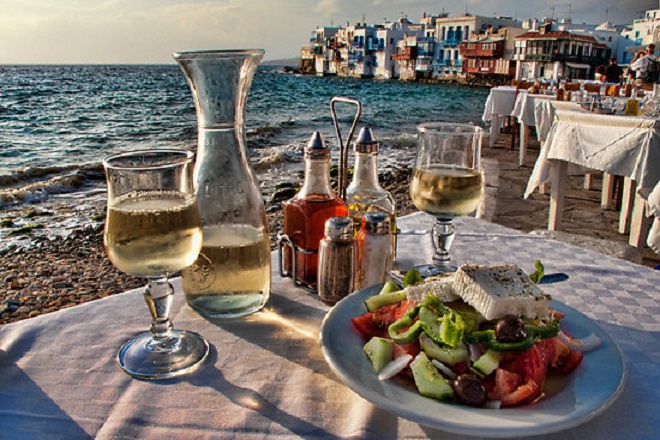
With less money to spend, and with a sense that local products are both appealing and less expensive, greek consumers demanded options in the form of “homemade” or pure wine served in carafes at restaurants. They also demanded cheaper, more casual, and smaller-portioned food options as an alternative to the more expensive, bigger meals served in formal restaurants.
This development has resulted, within the past two years, in a sharp increase of wine bars and by-the-glass consumption.
In addition, taxes on hard alcohol like vodka and whiskey have increased while taxes on wine have stabilized. On-premise establishments like trendy clubs in the cities have started carrying wine, whereas before they carried spirits for cocktails.
The combination of these factors bodes well for wine’s position within Greece’s social culture.
But trying to break away from the family farm, in search of education and professional opportunities elsewhere, had become the norm for younger generations. “We all grew up thinking we’d work in offices,” said Vivi Papaspirou, enologist at Boutari’s winery in Crete. “It’s an adjustment to think we’d be working with our hands. The people who work the harvest now are still getting used to the idea.”
With younger generations returning to the countryside (however unplanned, initially, that move may have been) the number of new producers has increased sharply in recent years. Voyatzis estimates that in the Naoussa region alone, in northern Greece, the number of producers has grown from just a handful to more than 25.
Yet, partly as a lingering sentiment of not expecting to work on the family farm, young people are much more likely to study as enologists rather than as viticulturalists. It is the difference between being a winemaker and being a grape grower, and between working inside the winery and outside of it, in the fields.
Balancing those two trends — a rush of new producers on the one hand, and a shortage of experienced viticulturalists on the other — will be a challenge moving forward.
